Integration Unpacked:
Walk the Walk
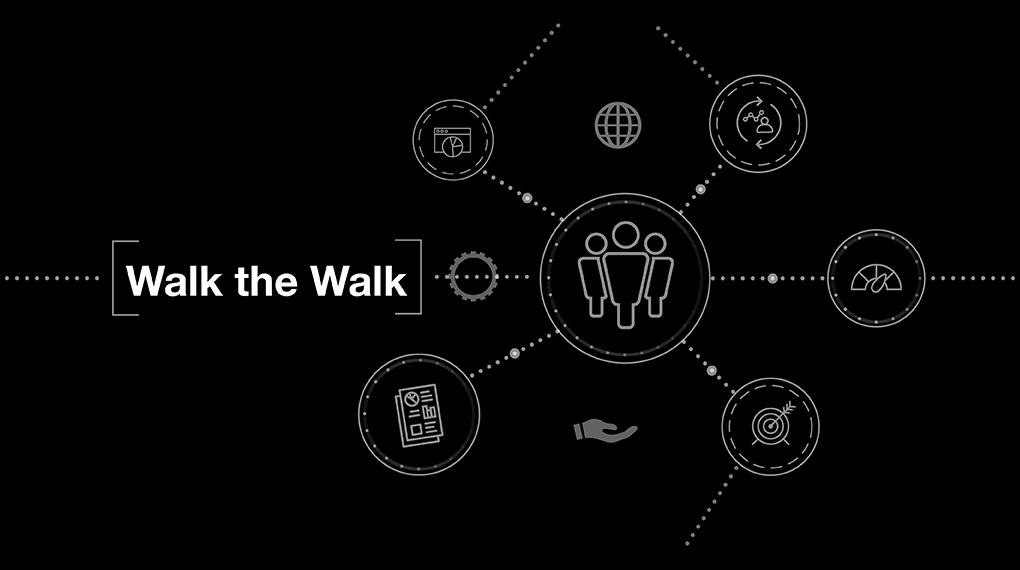
The best performances are built on what happens backstage. An integrated strategy is no different — its strength comes from the structures and decisions taking shape behind the scenes.
In our research on integrated business and sustainability strategies, we've seen that true integration shows up in the structures and processes that many stakeholders never see, from how boards assign accountability to how capital gets deployed. Last week, we looked at how highly integrated companies talk the talk. This week, we're looking under the hood to see whether companies are also walking the walk.
Across our cohort of 122 highly integrated companies, three patterns stood out. Let’s explore what sets this group apart.
Three signs that sustainability is embedded in business decisions:
1. Integrated governance structures
Rather than silo sustainability, highly integrated companies formalize it in their core governance and risk management processes. This ensures that sustainability is treated like other strategic business priorities: with clear ownership among company leadership and accountability for performance over time.
In our analysis:
- 46% of highly integrated companies have explicit board-level sustainability or environmental, social and governance committee language in their governance disclosures.
- 38% describe cross-functional sustainability steering committees.
These metrics establish a baseline for formal governance, but the more meaningful figures signal how far those governance structures reach. Among the cohort, 78% show strong evidence of cross-functional steering committees with named executive leads. Unilever, for example, assigns each sustainability target to a named executive sponsor from its leadership team, with implementation distributed across dedicated sustainability roles in finance, R&D and supply chain. An even larger portion of the cohort — 85% — has binding contractual sustainability requirements for direct suppliers, extending sustainability expectations into the value chain.
Another metric that adds to the picture: About 94% of highly integrated companies link some form of executive compensation to sustainability outcomes. This connection creates a level of accountability that is on par with other business decisions.
One more point of nuance on leadership: Our research found that only 35% of the cohort explicitly names a Chief Sustainability Officer (CSO) or equivalent. That finding does not diminish the importance of CSOs; however, it points to different models of integration, with some companies distributing sustainability responsibilities across functions rather than concentrating them in a single role.
2. A single strategic plan
For highly integrated companies, sustainability is part of how business decisions are made. Most large public companies conduct materiality assessments, but the assessment itself doesn't prove integration. What truly matters is whether the findings reshape capital allocation or product strategy.
That kind of decision-making is most visible in companies with labeled, enterprise-wide frameworks that shape both sustainability and business strategies. Examples include PepsiCo’s Pep+, John Deere’s Leap Ambitions, Johnson & Johnson’s Health for Humanity, and Cummins’ Destination Zero. Through Health for Humanity, for example, Johnson & Johnson is making progress toward a renewable energy target, with 88% of its global electricity sourced from renewables as of 2025. The target is managed inside the same framework that governs areas such as R&D and health-access investments, helping Health for Humanity function as an integrated business strategy, rather than a siloed sustainability program.
3. Capital allocation tied to sustainability outcomes
Every highly integrated company in our cohort discusses sustainability in financial terms, yet only 62% show strong evidence of sustainability-linked capital allocation. Companies that clear this bar make investment decisions in which sustainability outcomes influence financial returns. Here are a few examples:
- Corning invested $900 million in a solar manufacturing facility tied to its Solar Market-Access Platform. The platform generated approximately $1 billion in revenue in 2024 and is projected to reach $2.5 billion by 2028, showing how a sustainability-linked investment can create a scalable revenue line.
- Mastercard has issued more than one billion sustainable-material cards and made a series of climate-product investments, including the Carbon Calculator, Climate Action Lab and a circular startup accelerator. In 2024, net revenues grew 12% while combined emissions fell by 7%, showing how sustainability can advance alongside business growth.
- Valero Energy’s multi-billion-dollar Diamond Green Diesel joint venture is now the largest renewable diesel producer in the United States, generating significant recurring revenue from a sustainability-oriented product line.
In each case, capital decision-making and sustainability outcomes are intertwined.
What comes next
Together, the factors above strongly indicate that integration is more than aspirational; it’s real. But there’s a difference between proving that integration exists and demonstrating performance. That difference comes down to measurement: systems and data that enable companies to track results.
Only 36% of our cohort show strong evidence of both structural integration and data maturity, meaning most still lag in this regard. Keep an eye out for our final post, where we'll look at what that infrastructure measurement requires and why it may be the hardest part of integration to get right.