Integration Unpacked:
Behind the Shift
“Integrated strategy” is the buzz-term defining the latest batch of reports. But what does it mean? And why is it gaining traction now?
The seeds of this trend grew from the wreckage of ESG backlash. From anti-ESG legislation to scaled-back DEI commitments, the political and market pressures against ESG have been impossible to ignore. But what doesn’t kill you makes you stronger. Rather than wilt under the heat, the sustainability movement has adapted and evolved.
What sustainability leaders are learning, and what we’re seeing made clear in recent reports, is that sustainability strategies become sturdier when clearly business aligned. In the face of economic and political headwinds, claims of “doing the right thing” can wear thin. What holds up are strategies that make good business sense. Risk mitigation, stakeholder confidence, the ability to tap into new markets — these are the tangible values that business-aligned strategies bring.
As companies tie their environmental and social initiatives directly to business outcomes, it’s reshaping how they communicate about sustainability, too. We wanted to unpack this evolution: What phases do companies move through as they integrate sustainability and business strategies? What do best practices and signs of progress look like? In this four-part series, we’ll get to the bottom of these questions and more.
Getting specific
We’ve already hinted at what an integrated strategy looks like, but it’s worth clearly defining:
- An integrated strategy is a unified approach that embeds sustainability priorities directly into a company’s business model to influence decisions such as product development or capital allocation.
- An integrated strategy is not a siloed workstream in which sustainability initiatives are pursued only for environmental or social benefits, regardless of business benefits.
- Put plainly, an integrated approach aligns sustainability outcomes with financial and market goals, operational decisions and value creation.
Under this approach, companies shift from asking, “What should sustainability issues should we tackle?” to “How do sustainability issues help influence where we invest, build and compete?” Integration also allows companies to play both offense and defense: offense by showing investors and other stakeholders where sustainability adds real value, and defense by building resilient, business-grounded rationales for these initiatives.
Understanding the framework
Integration isn’t binary. Companies sit along a spectrum, ranging from sustainability as a “check-the-box” project to a core driver of business strategy. Some treat sustainability as a compliance obligation. Others see it as both a risk mitigation tool and a competitive advantage.
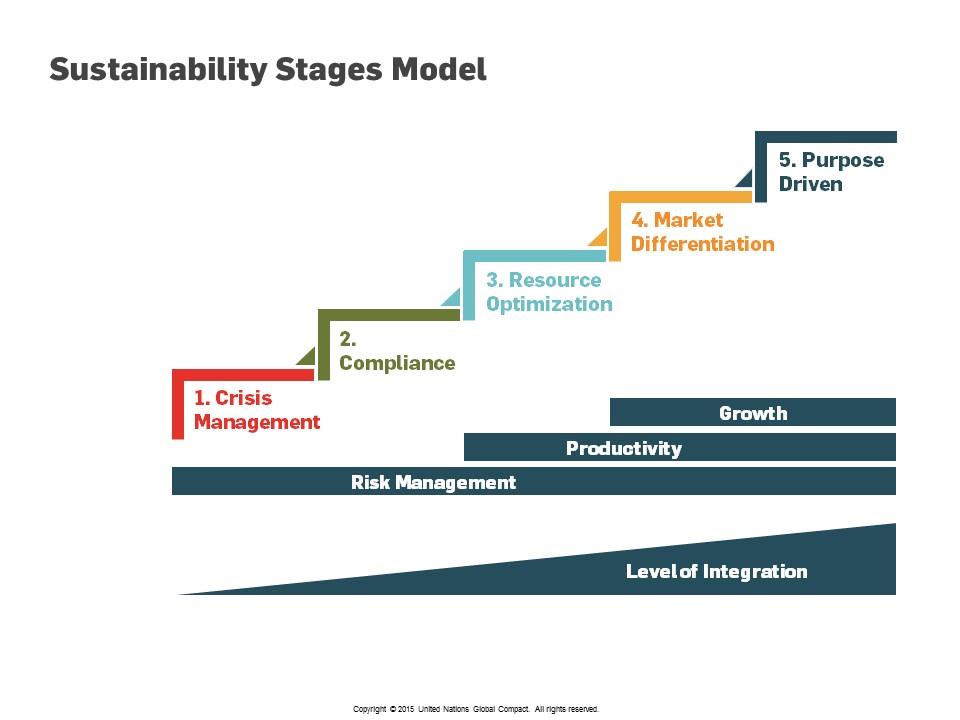
To make sense of where companies fall, we turned to the UN Global Compact (UNGC), which uses a five-stage framework for sustainability integration. The framework maps a progression from companies that treat sustainability as a crisis management exercise (Stage 1) to those whose businesses are truly purpose-driven (Stage 5).
[View Description]
A step diagram showcasing five stages of sustainability integration alongside their business benefits:
- Crisis Management (Lowest integration)
- Compliance
- Resource Optimization
- Market Differentiation
- Purpose Driven (Highest integration)
Associated benefits over time: Risk Management spans all five phases. Productivity benefits begin at Stage 3 (Resource Optimization). Growth benefits begin at Stage 4 (Market Differentiation).
In our analysis, most large companies fall somewhere around the resource optimization phase (Stage 3), where sustainability is pursued primarily as a driver of operational efficiency and cost savings, rather than as a source of competitive advantage. Moving a step forward makes a difference; according to the UNGC, the biggest leap toward integration happens between the resource optimization phase (Stage 3) and market differentiation phase (Stage 4). At this point, companies stop treating sustainability as a risk-management exercise and start connecting it to business value.
Analyzing the current state
We used this phase-3-to-phase-4 leap to define our research on integrated strategies. We analyzed approximately 300 companies, based loosely on the S&P 500 in the first quarter of 2026, mapping five criteria for each company — strategic orientation, functional integration, operational characteristics, governance and leadership, and innovation and market positioning — to one of the UNGC’s sustainability stages. From this sample, we identified 122 companies, about 39% of our sample, as highly integrated.
Consistent hallmarks of these companies included:
- Communicating an integrated strategy clearly
- Integrating accountability mechanisms and oversight for that strategy
- Establishing a credible framework for measuring strategy effectiveness over time
In the coming weeks we’ll explore each hallmark, starting with how highly integrated companies frame sustainability as a business opportunity. We found that there’s a lot to learn here. After all, if you want to understand a trend, it helps to look at those on the leading edge. Stay tuned.